
Uncategorized
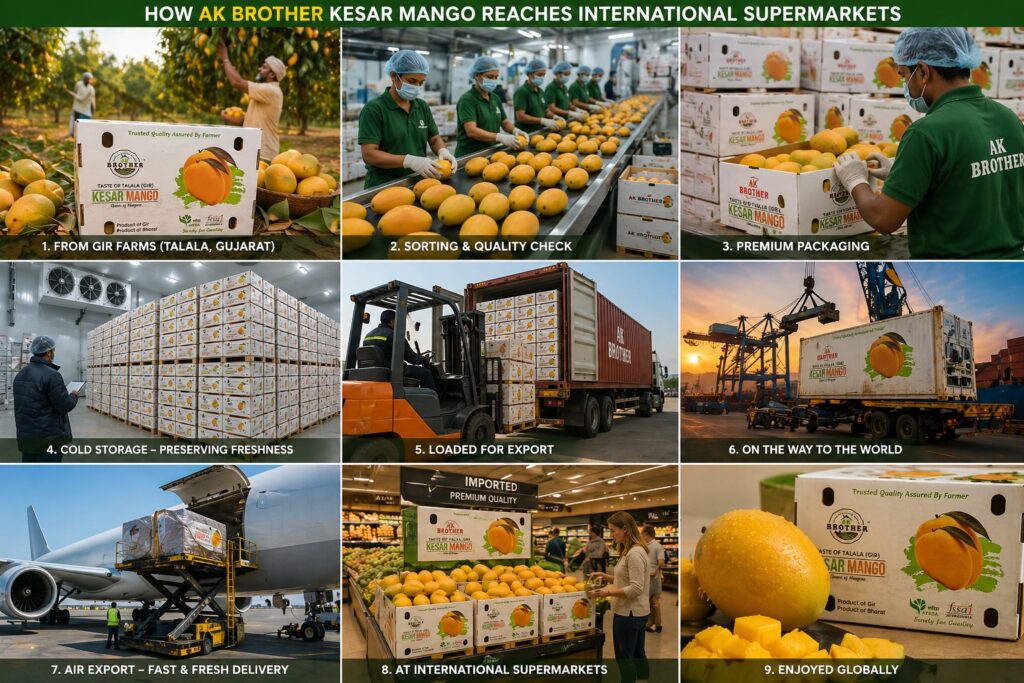
How Kesar Mango Reaches International Supermarkets
05
May
May
Kesar mango, famously known as the “Queen of Mangoes,” is one of India’s most premium fruit exports. Its rich aroma, vibrant saffron pulp, and naturally sweet taste make it highly desirable in international markets. Every year, thousands of tons of Kesar mangoes are exported from India to countries like the USA, UK, UAE, Canada, and Singapore.
But behind this global availability lies a highly organized process involving farmers, exporters, logistics providers, and strict international compliance systems. The journey of Kesar mango from farms in Gujarat to international supermarket shelves is not just about transportation—it is about maintaining quality, freshness, and trust.
Kesar mango is one of India’s most premium fruits, loved globally for its taste and aroma. The demand in international markets is growing every year. Through Indian mango export, this fruit reaches supermarkets worldwide. Its journey involves quality control, logistics, and global standards.
In this detailed guide, we will explore step-by-step how Kesar mango reaches global consumers through a well-structured Indian mango export system.
1. Cultivation in Gujarat – The Foundation of Quality
The journey of Kesar mango begins in the fertile lands of Gujarat, especially in the Gir and Junagadh regions. The soil composition, climate, and farming expertise in this region give Kesar mango its unique identity.
Kesar mango is mainly grown in Gujarat’s Gir region, known for its ideal climate and soil. Farmers use traditional and modern techniques to ensure high-quality produce. This strong foundation supports successful mango export from India. Quality begins right from the farm level.
Farmers follow a combination of traditional and modern agricultural practices such as:
- Natural ripening methods
- Controlled irrigation systems
- Use of organic fertilizers
- Pest management techniques
These practices ensure that mangoes meet international quality standards, which is essential for successful mango export from India.
2. Harvesting at the Perfect Stage
Harvesting is one of the most critical steps in the mango export process. Mangoes are not picked when fully ripe; instead, they are harvested at a mature but unripe stage.
Because mangoes continue to ripen after being harvested. If they are picked too late, they may spoil during transportation.
Key harvesting practices include:
- Hand-picking to avoid damage
- Selecting uniform size and color
- Avoiding overripe or diseased fruits
Only the best-quality mangoes are selected for premium mango export India, ensuring consistency in global markets.
3. Sorting and Grading for Export Quality
After harvesting, mangoes are sorted based on size, color, and quality. Only premium-grade fruits are chosen for international markets. This ensures consistency in exports. Mango export companies India follow strict grading standards.After harvesting, mangoes are transported to processing units where they undergo sorting and grading.
They are classified based on:
- Size
- Weight
- Color
- External appearance
Grades typically include:
- Export Quality (Premium)
- Domestic Grade
- Processing Grade
Only premium-grade mangoes move forward in the export chain, which is why mango export companies India invest heavily in quality control systems.
4. Washing and Hot Water Treatment
Mangoes are washed and treated with hot water to remove pests and bacteria. This process ensures compliance with international safety norms. It is mandatory for many countries. It strengthens trust in Indian mango export.Before packaging, mangoes must be cleaned and treated to meet international safety standards.
This process includes:
- Thorough washing to remove dirt and latex
- Hot water treatment to eliminate pests and larvae
- Fungicide treatment (as per importing country regulations)
Hot water treatment is mandatory for many countries, including the USA and Australia. It ensures that the fruit is pest-free and safe for consumption.
This step is essential in maintaining the reputation of Indian mango export in global markets.
5. Advanced Packaging Techniques
Export-quality mangoes are packed in ventilated and protective boxes. Proper packaging prevents damage during transit. Labels include origin and export details. This helps maintain quality in mango export from India.Packaging plays a vital role in protecting mangoes during long-distance travel.
Exporters use:
- Corrugated fiberboard boxes
- Ventilated cartons for airflow
- Cushioning materials to prevent bruising
Each box is labeled with:
- Product name (Kesar Mango)
- Country of origin (India)
- Exporter details
- Batch number
Modern packaging innovations used by mango export companies India help extend shelf life and maintain fruit quality.
6. Cold Chain Management – Keeping Mangoes Fresh
Temperature control is critical to keep mangoes fresh. Pre-cooling and refrigerated transport slow down ripening. Cold chain systems ensure quality during long journeys. This is key for premium mango export India.
One of the biggest challenges in mango export from India is maintaining freshness during transit.
To solve this, exporters use cold chain logistics:
- Pre-cooling mangoes after packing
- Storing at controlled temperatures (usually 10–13°C)
- Using refrigerated trucks and containers
Cold chain management slows down the ripening process and prevents spoilage.
Without this system, premium mango export India would not be possible at a global scale.
7. Documentation and Export Compliance
Export requires certificates, licenses, and quality checks. These documents ensure compliance with global standards. Authorities like APEDA guide exporters. This builds credibility in Indian mango export.
Exporting mangoes involves strict documentation and regulatory compliance.
Key requirements include:
- Phytosanitary Certificate
- Certificate of Origin
- Export License
- Residue Testing Reports
Organizations like APEDA support exporters by setting standards and providing certifications.
Compliance ensures that Indian mango export meets international food safety regulations and builds trust with global buyers.
8. Arrival and Distribution in International Markets
Once the mangoes arrive in the destination country:
- They undergo inspection by customs authorities
- Quality checks are performed
- Approved shipments are sent to distributors
Distributors then supply mangoes to:
- Supermarkets
- Retail chains
- Specialty fruit stores
This efficient supply chain is managed by experienced mango export companies India working with global partners.
9. Supermarket Display and Consumer Experience
In international supermarkets, Kesar mango is positioned as a premium product.
Retailers highlight:
- “Imported from India” label
- Seasonal availability
- Premium quality
Mangoes are stored under controlled conditions to maintain freshness until purchase.
Consumers value Kesar mango for:
- Its unique taste
- Authentic Indian origin
- Limited seasonal supply
This strong demand drives the growth of Indian mango export worldwide.
10. Challenges in Mango Export
Despite its success, the industry faces several challenges:
- Short shelf life of mangoes
- Strict international regulations
- High logistics costs
- Climate dependency affecting production
However, continuous improvements in supply chain management are helping overcome these challenges.
11. Role of Technology in Mango Export
Technology is transforming the export industry.
Innovations include:
- Supply chain tracking systems
- Temperature monitoring sensors
- Automated grading machines
- Digital export documentation
These advancements are improving efficiency and boosting the reliability of mango export from India.
12. Global Demand for Kesar Mango
Kesar mango has a strong presence in international markets due to:
- Premium quality and taste
- Strong brand value of Indian mangoes
- Growing demand for exotic fruits
- Increasing Indian diaspora worldwide
Countries like the UAE, UK, and USA are major importers, making Kesar mango a key product in premium mango export India.
13. Future of Indian Mango Export
The future looks promising for the mango export industry.
Growth drivers include:
- Expanding global markets
- Improved cold chain infrastructure
- Government support and subsidies
- Increasing online fruit delivery platforms
India is expected to strengthen its position as a global leader in mango exports, further boosting Indian mango export.
1. What is Kesar mango and why is it famous internationally?
Kesar mango is a premium variety grown mainly in Gujarat, India. It is famous for its rich aroma, saffron-colored pulp, and naturally sweet taste, making it highly popular in global markets.
2. Which countries import Kesar mango from India?
Kesar mangoes are exported to countries like the USA, UK, UAE, Canada, and Singapore due to high demand for premium Indian mangoes.
3. How are Kesar mangoes harvested for export?
Mangoes are harvested at a mature but unripe stage to ensure they ripen properly during transit and do not spoil before reaching international markets.
4. What is the role of sorting and grading in mango export?
Sorting and grading ensure only high-quality, uniform mangoes are selected for export. This helps maintain consistency and meet international standards.
5. Why is hot water treatment important for mango export?
Hot water treatment removes pests and bacteria, ensuring the mangoes meet strict food safety regulations required by importing countries.
Conclusion
The journey of Kesar mango from Gujarat’s farms to international supermarket shelves is a complex yet well-organized process. It involves careful cultivation, strict quality checks, advanced logistics, and compliance with global standards.
Every step—from harvesting to retail display—is designed to maintain the mango’s freshness, taste, and premium quality. Thanks to the efforts of farmers, exporters, and mango export companies India, Kesar mango continues to delight consumers across the world.
With increasing demand and technological advancements, mango export from India is set to grow rapidly. The excellence in premium mango export India ensures that the rich taste of Kesar mango reaches global consumers in its best form.